Measure, quantify, and report climate risk with financial-grade rigor.
Alpha-Klima connects best-available climate data, asset-level vulnerability models, and a financial risk engine to turn climate complexity into clear, auditable insight for portfolios and assets.
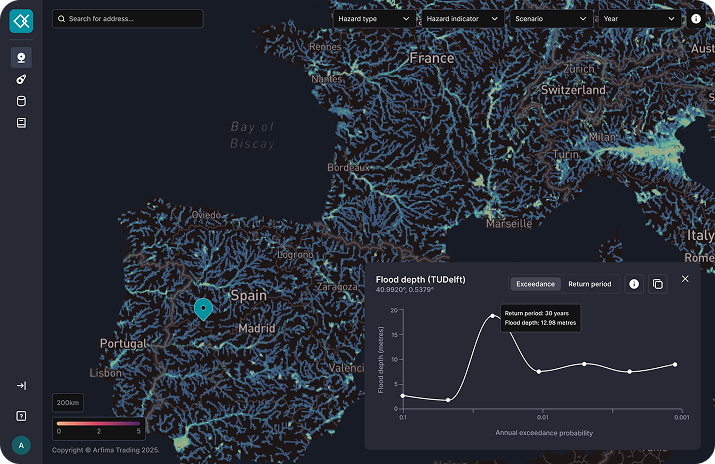
Identify where and how physical hazards — flood, heat, wind, wildfire, and drought — affect your assets and supply chain at asset level.
Financial impact
Translate physical damage and operational disruption into loss distributions and financial risk metrics such as VaR and Expected Shortfall across scenarios and time horizons.
Disclosure
Generate outputs aligned with regulatory and reporting frameworks, including CSRD and banking Pillar 3 requirements.
What you get
End-to-end platform
A complete workflow from climate data ingestion to financial risk outputs, designed for enterprise and regulatory use cases.
Asset-level models
Asset-specific vulnerability models with configurable damage and loss functions based on downscaled projections and observed data.
Decision-ready metrics
Comparable financial metrics (VaR, ES) across scenarios and horizons to support risk management and strategic decisions.
Audit-ready reporting
Structured reports and exportable datasets for internal stakeholders, auditors, and regulators.
Engineered to Meet the Highest Standards
Hazard
Curated hazard layers and downscaled climate projections define the intensity and frequency under multiple scenarios.
Exposure
Assets, geographies, and supply-chain elements are mapped to hazard layers with full traceability.
Vulnerability
Asset-specific vulnerability functions convert hazard intensity into physical damage and disruption estimates.
Financial risk
Damage and disruption are translated into loss distributions, portfolio metrics, and scenario-based financial risk outputs.
What it solves
Climate data & scenarios
Latest GCM-based projections combined with satellite and observational datasets, supporting RCP/SSP pathways, time slices, regions, and versioned inputs for auditability.
Quantitative engine
Advanced modeling of asset damage and cash-flow interruption to quantify losses at both asset and portfolio level.
Web & APIs
Interactive dashboards for exposure, impact, and financial risk, plus API access for seamless integration with BI, risk, and reporting systems. AI-assisted reporting available.